
Breast Augmentation Toronto
Considering breast augmentation is a personal decision, and many patients explore it for a variety of reasons, including changes after pregnancy, weight loss, or to adjust breast shape or volume.
At La Fontaine Source de Jeunesse in Yorkville, Toronto, we offer consultations to discuss options, assess suitability, and review expected outcomes. During the consultation, patients are encouraged to ask questions and discuss any concerns so they can make an informed decision.
Consultations are provided at no cost and are non-obligatory. When appropriate, we may also offer 3D imaging to help illustrate potential outcomes as part of the planning discussion.
The goal of the consultation is to provide information and support patients in understanding their options so they can decide whether treatment is appropriate for them.
Are You a Good Candidate for Breast Augmentation?
Before undergoing breast augmentation, it is important to have a thorough understanding of the procedure, including its benefits, limitations, and potential risks, as well as to maintain realistic expectations. The decision should be patient-driven and based on personal goals rather than external influence.
Breast augmentation may be considered for a variety of reasons, including breast volume enhancement, correction of asymmetry, restoration of breast volume following pregnancy or weight changes, or in some cases breast reconstruction following illness or surgery. During consultation, suitability is assessed individually based on medical history, anatomy, and patient goals.
Certain conditions or circumstances may require postponing or avoiding elective breast surgery, including active infection, pregnancy, and breastfeeding. A full medical assessment is required prior to determining candidacy.
Implant type, size, and placement are selected on an individual basis following clinical assessment and discussion of options, with the goal of achieving a balanced and appropriate result for each patient.
Get a Quote
What to Expect During Your Breast Augmentation Consultation
Your breast augmentation journey starts with a complimentary consultation with one of our qualified professionals. In this consultation, you will be given a full assessment of what you can expect during your stay with us. We ensure that your goals are discussed and understood and a full health background check is established. All of your questions about the facility and the procedure can be answered during this consultation. You will also be informed of the costs of your procedure and have the opportunity to discuss payment options.
Your second visit with us is where you will meet with the doctor (cosmetic surgeon). In this meeting you will discuss your personalized goals and desires and the doctor will discuss the procedure and recovery proc
Please contact us to set up your complimentary breast augmentation consultation today!
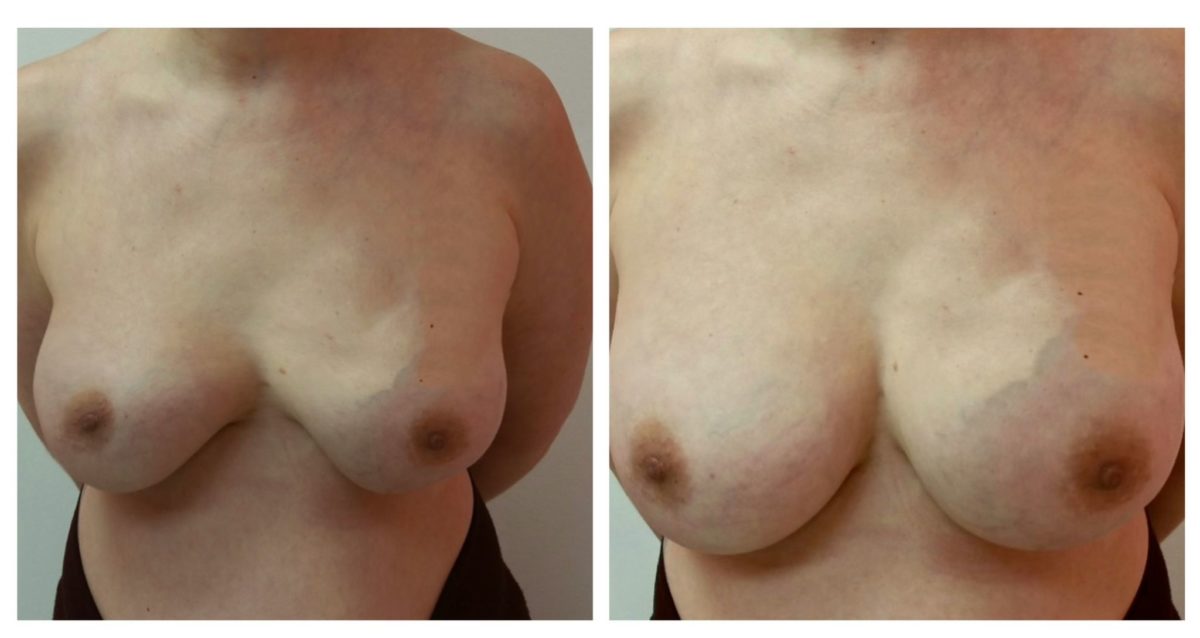
Below is a sample of breast implant and breast after photos from our patients.
Different Breast Augmentation Techniques
Different methods of breast augmentation can lead to less scarring and bleeding, as well as affect the overall appearance and feel of the transplant. The most common technique is trans-axillary breast augmentation where the incision is made through the armpit to eliminate any scarring on the breasts. This technique has many benefits, however, to increase the risk of capsular contracture after surgery it is best to decrease the risk of bleeding during and after surgery.
Bloodless Breast Augmentation
One surgical approach that may be used in breast augmentation is referred to as a “bloodless” or low-blood-loss technique. This involves careful dissection and control of bleeding during surgery using standard electrocautery instruments to minimize intraoperative bleeding. Incisions are typically made in standard locations such as the inframammary fold or periareolar region, depending on patient anatomy and surgical planning.
Potential benefits of meticulous haemostasis during surgery may include reduced intraoperative bleeding and potentially less postoperative bruising and swelling. Postoperative pain and recovery experiences vary between patients and are influenced by multiple factors, including surgical technique, implant size, and individual healing response.
Another technique that may be used during breast augmentation is the use of an implant delivery device, such as a funnel system, to assist with implant insertion. This method is designed to allow the implant to be placed into the surgical pocket with reduced direct contact, which may help maintain sterility and facilitate insertion through a smaller incision in appropriate cases.
The device is typically a single-use sterile sleeve that allows the surgeon to guide the implant into the breast pocket in a controlled manner. The specific method of implantation is determined by the operating surgeon based on clinical judgment, implant type, and patient factors.
Overall, surgical technique and tools are selected based on patient anatomy and surgical goals, with the aim of performing the procedure safely and appropriately for each individual.
Transferring Fat for Breast Augmentation
If patients prefer not to use breast implants, autologous fat transfer may be considered as an alternative method of breast augmentation in selected cases. This technique involves harvesting fat from one area of the body using liposuction, processing it, and then reinjecting it into the breasts to increase volume and improve contour.
Fat transfer may provide a modest increase in breast volume and is generally best suited for patients seeking subtle enhancement. The degree of augmentation is typically limited compared to implants, and multiple sessions may be required to achieve desired results. Not all patients are suitable candidates, particularly those with limited donor fat or those seeking a larger or more significant volume change.
Suitability for fat transfer is determined on an individual basis following clinical assessment. This includes evaluation of overall health, available donor sites, and breast tissue characteristics.
The procedure involves two components: liposuction to harvest fat from donor areas such as the abdomen or thighs, and subsequent injection of processed fat into the breast tissue. Postoperative swelling and bruising may occur at both donor and recipient sites, and recovery varies between patients.
Some of the transferred fat may not survive, and partial resorption is expected. The final outcome is therefore not entirely predictable and may vary between individuals.
Potential risks include those associated with liposuction and fat grafting, as well as asymmetry, fat necrosis, and changes in breast volume over time. Patients are counselled regarding risks, benefits, and alternatives as part of the informed consent process.
Fat transfer may be discussed further during consultation where appropriate, based on individual goals and clinical suitability.
Placement of Incisions
The length of the incision in breast augmentation surgery varies depending on implant type, surgical technique, and patient anatomy. In general, incision lengths are typically in the range of approximately 3–5 cm, although this may vary. Silicone implants often require slightly longer incisions than saline implants due to differences in implant form and insertion requirements. Individual healing and scarring tendencies also vary between patients.
Common incision locations include:
- Inframammary fold (under the breast)
- Periareolar (around the lower edge of the areola)
- Transaxillary (within the armpit)
- In select cases, transumbilical (through the navel), which is used less commonly and is generally limited to saline implants
The choice of incision site is based on multiple factors, including implant type, surgical plan, anatomy, and surgeon assessment. Each approach has potential advantages and limitations, and no single incision type is appropriate for all patients.
The inframammary approach is commonly used as it provides direct access to the breast pocket and is widely applicable for different implant types and placement planes. The periareolar approach may be considered in selected patients, but it carries specific considerations, including potential effects on nipple sensation and breastfeeding ability, which are discussed during informed consent. The transaxillary approach avoids a breast scar but may limit direct visibility during implant placement depending on technique and instrumentation.
The transumbilical approach is less commonly performed and is generally limited to saline implants, as implant delivery is performed in a different manner compared to silicone devices.
Postoperative healing and scar appearance vary between individuals. Patients are advised that adherence to postoperative instructions is important for optimal healing. Factors such as physical activity, wound care, and individual biology can influence recovery and scar formation. Scar management options may be discussed during follow-up where appropriate.
Preparing for Your Breast Surgery
While many patients may be considered for breast augmentation, suitability is determined on an individual basis following a clinical assessment. Factors such as breast anatomy, skin quality, degree of ptosis (sagging), overall health, and patient goals are taken into account when determining whether augmentation alone is appropriate or whether an alternative or additional procedure (such as mastopexy or breast reduction) may be more suitable.
Breast augmentation is typically performed as an elective day surgery under general anaesthesia. In most cases, patients are able to return home the same day, provided there are no immediate concerns following the procedure. A surgical plan is developed in advance, including implant type, placement, and incision location, based on clinical findings and informed discussion.
For patients proceeding with surgery, pre-operative preparation is an important part of care. This may include a medical review, discussion of current medications and supplements, and guidance on temporary discontinuation of certain agents that may increase bleeding risk, when clinically appropriate. Smoking cessation is also advised prior to surgery due to its impact on wound healing and recovery.
Patients are also provided with specific pre-operative instructions, which may include fasting requirements prior to anaesthesia and arrangements for transportation home following the procedure, as patients are not able to drive themselves after surgery.
Post-operative care instructions are reviewed in advance to support safe recovery, including guidance on activity restrictions, wound care, and follow-up visits. Patients are encouraged to contact the clinic if they have any questions prior to surgery so that instructions are clearly understood.
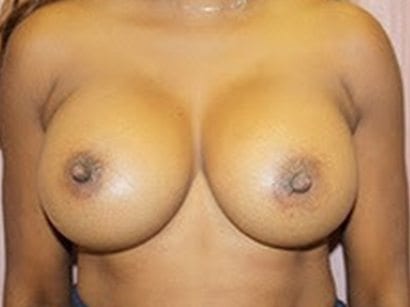
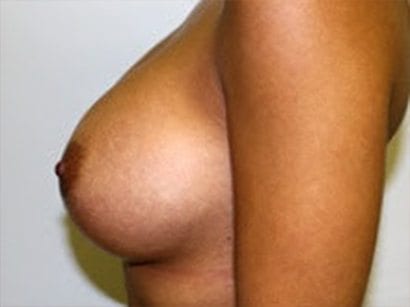

A consultation is an important step in the breast augmentation process and is intended to help patients understand available options, including implant sizing, placement, and expected outcomes.
Implant sizing is typically determined using a combination of clinical assessment, patient goals, and anatomical considerations. In some cases, sizing tools or imaging simulations may be used during consultation to help patients visualize potential outcomes. Final implant selection is individualized and made in collaboration with the treating surgeon.
Implant size can influence both aesthetic outcome and surgical considerations. Larger implants may be associated with increased risk of complications such as implant malposition, including inferior displacement (“bottoming out”), and may place greater strain on surrounding soft tissue. Adequate native breast tissue coverage is also an important factor in reducing visibility of implant edges and achieving a natural contour.
It is also important to note that perceived breast size may change after surgery as swelling resolves and implants settle into position. Final results may therefore differ from early postoperative appearance.
All implant-related decisions, including size selection, are made based on clinical evaluation, patient anatomy, and informed discussion of risks and benefits.
What Type of Breast Implant Should I Choose?
Several factors are considered when selecting an implant type, and the choice is individualized based on patient anatomy, goals, and clinical assessment.
Implants may differ in shape, surface texture, and filling material. Common implant shapes include round and anatomically shaped (often referred to as “teardrop” implants). Round implants are symmetrical and may provide more uniform upper pole fullness, while anatomically shaped implants are designed with more projection in the lower portion to more closely resemble natural breast contour. Each option has specific indications, and suitability depends on individual anatomy and desired outcome.
Implant surfaces may be smooth or textured. Smooth implants allow the implant to move more freely within the breast pocket, while textured implants were developed with the intention of reducing implant movement and certain complications in specific clinical contexts. Each surface type has associated benefits and considerations that are discussed during consultation.
Implants also differ by filler type, most commonly silicone gel or saline. Silicone implants are pre-filled with a cohesive gel and are often selected for their consistency and tissue-like feel. Saline implants are filled with sterile salt water at the time of surgery, allowing for intraoperative adjustment of volume and, in some cases, smaller incisions. Each type has distinct characteristics, including differences in feel, adjustability, and imaging appearance.
Implant selection is made following a detailed consultation where options are reviewed, and decisions are based on clinical findings, patient preferences, and informed discussion of risks and benefits.
Both silicone and saline breast implants are licensed medical devices in Canada and are available in a range of profiles, including high-profile implants. The choice between implant types depends on factors such as patient anatomy, desired outcome, incision approach, and surgeon assessment.
Silicone implants are filled with cohesive silicone gel and are available in different gel consistencies and shapes. They are commonly selected for their tissue-like feel and ability to maintain shape. Silicone implants are pre-filled and therefore require an incision large enough to accommodate the implant at the time of insertion. Different silicone implant types may vary in firmness, projection, and likelihood of visible rippling or wrinkling.
Saline implants consist of a silicone shell that is filled with sterile saline solution during surgery. Because the implant is filled after insertion, a smaller incision may be possible in some cases. Saline implants also allow for limited intraoperative volume adjustment, which may assist in addressing mild asymmetry. However, saline implants may have a greater likelihood of visible rippling in some patients, particularly in individuals with thinner soft tissue coverage.
Implant profile, including “high-profile” implants, refers to the relationship between implant width and projection. Profile selection is individualized and based on chest dimensions, tissue characteristics, and aesthetic goals discussed during consultation.
The choice of implant type and profile is made following a detailed clinical assessment and informed discussion of the potential benefits, limitations, and risks associated with each option.
Breast implants can be placed either above the chest muscle (under the breast itself) or under the chest muscle. Above the chest muscle implants are called sub-glandular or sub-mammary. Under the chest muscle implants are called sub-muscular or sub-pectoral. Although both types of implant placements are appropriate for all patients, they each have their own advantages and disadvantages.
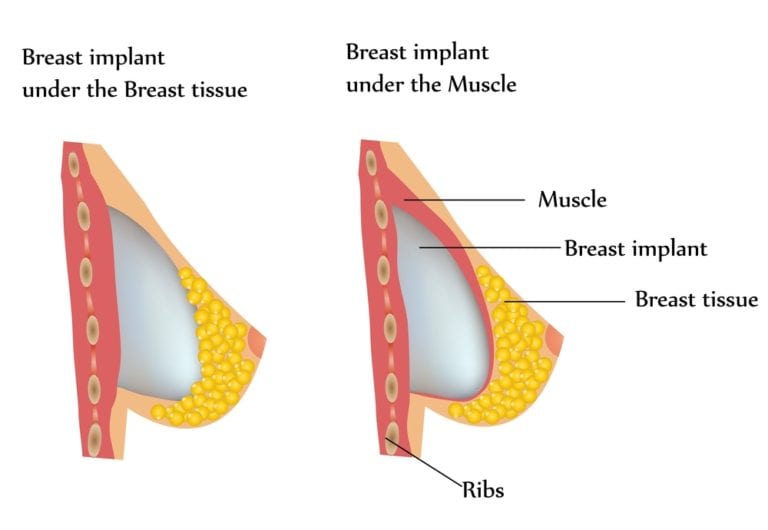
Subglandular placement refers to positioning the implant above the pectoralis muscle and beneath the breast tissue. In selected patients, this approach may provide greater upper breast fullness and may involve a shorter recovery period. However, in some individuals, implants placed in this position may be more visible or palpable, particularly in patients with thinner soft tissue coverage. Additional considerations may include increased visibility of implant rippling and potential differences in mammographic imaging.
Submuscular placement involves positioning the implant partially or fully beneath the pectoralis muscle. This approach may provide additional soft tissue coverage in the upper portion of the breast and may reduce visibility or palpability of the implant in some patients. It may also influence implant support and imaging characteristics. Recovery experiences and postoperative discomfort can vary between individuals and surgical techniques.
Each implant placement option has potential benefits and limitations, and no single approach is appropriate for all patients. The recommended implant plane is determined following clinical assessment and discussion of individual goals and anatomy.
Common incision approaches for breast augmentation include:
- Transaxillary (through the armpit)
- Inframammary (through the breast fold)
- Periareolar (around the lower border of the areola)
The choice of incision location depends on factors such as implant type, anatomy, and surgeon assessment. Risks, benefits, and alternatives are reviewed during consultation as part of the informed consent process.
Recovering from Your Breast Augmentation Surgery

In capsular contraction, this protective layer abnormally hardens, causing the breast implant to deform or compress. As a result, the breast itself tightens and rises higher on the chest. This can be followed with hardness and pain in the breast. In most cases, this can be alleviated by applying external pressure. This is done by your cosmetic surgeon at the La Fontaine clinic with or without sedation. They will correct the problem, making your breast feel soft again. In very rare cases, the surgeon may need to open the incision to achieve the same result. Today`s safe and technological-improved breast implants have reduced the incidence of capsular contraction to less than 5%.
There are several criteria needed to properly diagnose capsular contraction, which are determined by the Baker Classification for capsular contraction.
- Grade I- The breast appears normal, having desired size, shape and softness
- Grade II- The breast becomes slightly firmer
- Grade III- The breast becomes hard and appears abnormal
- Grade IV- The breast is hard, painful and looks abnormal
For the first while, avoid spending too much time examining your breasts. Devote this time to mental and physical relaxation for your state of mind. A positive attitude plays an important role in your overall results.
After the surgery you will be taught how to properly massage your new breasts to prevent improper positioning of the implants and help keep them soft. Special instructions will be given to those who undergo breast lifts with their breast augmentation.
Massaging is usually done regularly for the first 3 months after your breast augmentation procedure is completed. The massaging then continues less frequently for up to a year after the procedure. There are several massaging techniques that you will be taught to help keep your breast implants in the correct placement. There are upward and downward massages. Upward massages push the implant upward to help the implant capsule to stretch. Downward massages are usually more beneficial for sup-muscular implants because these implants sit higher on the chest. Downward massages help the implant to settle downward. Further, massaging your breast implants toward each other helps to better outline cleavage.
You might find that a breast on either side may take longer to settle than the other, which is normal.
In the case of capsular contraction, you will be given special instructions by your doctor or a nurse on what massage techniques to use to heal and prevent a repeat of this complication.
Wearing the right bra after having a breast augmentation is very important. Your bra can significantly affect the appearance of your new breasts and even contribute to complications. It is best that you avoid wearing an underwire bra for at least the first 2 months after surgery. The underwire can irritate or cut into the incision under the breast fold. As well, the breast implants need time to settle into their shape and an underwire or push up bra can interfere with this process.
You will most likely need to buy new bras after undergoing breast augmentation. You want to make sure that your new bras fit correctly in order to support your new breasts and avoid drooping or bottoming out.
The following criteria provide a guide on how a proper bra should fit:
- Bra straps should sit comfortably along shoulders without falling off or digging into skin. Adjust straps to a comfortable fit and for adequate support.
- The centre panel of the bra should sit comfortably on the area between your breasts. If the panel does not rest on your skin, this could mean that the bra size is too small.
- The band of the bra at the back should be parallel to or slightly lower than the front. If the band rides up or causes rolls in your backs, the bra could be too small.
- Cups should fit comfortably against your breasts. Spaces between cups and breasts indicate that the bra is too big
In rare cases, there can be complications that can occur after any surgery such as infection and bleeding.
Antibiotics can be used before and after surgery to prevent infections. If an infection arises in another part of your body it is crucial that it be treated immediately so that it does not spread to the vulnerable section of your breast augmentation. If an infection does occur in the breasts, the implant must be removed and a replacement implant can be inserted after 9 months of the infection being treated.
In very rare cases, breast implants can rupture or deflate due to tearing of the shell by capsular contraction or physical trauma. If a rupture or tear does occur, the actions for treatment depend on the type of implant. Silicone implants will not leak into the body nor does the body absorb it. However, surrounding tissue around the ruptured implant will thicken which can deform the shape of the breast or make it hard.
Saline implants will leak if ruptured. Fortunately, the saline solution is not dangerous to the body. In this case, the implant will deflate and the appearance of the breast will change.
Once tests are done to check if the implant is intact or not, the implant will need to be removed and replaced. Usually this process is simple and precautions taken when the original implant was inserted will need to be adhered to again.
Other potential but extremely rare problems that may occur after breast augmentation surgery include:
- Rash on or around breasts
- Hypertrophic scarring, which is a deep, red scarring that occurs after surgery
- Inflammation of blood vessels under the breasts
- Fluid build-up around the implant which causes swelling and pain
- Separation of the edges of the wound, causing opening of the incision as oppose to healing
- Changes in nipple sensitivity
All breast implants will have some degree of wrinkling. Folds on the shell of the implant occur because the implants are soft. Usually this wrinkling is felt when certain movements are made, such as leaning forward. However, it may become a problem if the wrinkles become visible. Saline implants are more likely to wrinkle than silicone ones.
There are several signs to be aware of and monitor to ensure the success and proper healing of your breast augmentation:
- You will experience some pain and discomfort in and around your breasts
- You may see bruising around your breast area
- Your breasts may swell
- You may experience slight bleeding near the incision
- You may feel nauseous or have constipation due to use of pain killers
Certain signs may indicate the need for emergency. In the case of the following, contact La Fontaine Source De Jeunesse Cosmetic Surgery Centre immediately:
- If you experience unbearable headaches
- If you are experiencing chest pain or shortness of breath
- If your wounds are bleeding excessively and do not show signs of stopping
- If your breasts appear abnormally swollen
If we are closed during the time that you call, go to your nearest hospital to be examined right away.
Though pain levels are largely based on a person`s pain tolerance, different procedures will result in experiencing slightly more pain than other procedures. For example, sub muscular, or under the chest muscle procedures usually are a bit more uncomfortable than sub-glandular procedures. Nevertheless, most patients who have undergone breast augmentation are able to resume to their normal activities a day or two after the procedure.
To avoid causing any complications or unnecessary pain, it is important to adhere to a few guidelines after having your breast augmentation surgery. These are:
- Refrain from wearing an underwire bra for up to 6 months after surgery. After this time, avoid wearing underwired bras for long periods of time.
- Sleep on your back only. Sleeping on your stomach or sides could alter the results of the augmentation or open wounds.
- Refrain from engaging in robust physical activity that would cause your breasts to bounce up and down. This may alter the placement of your implants or re-open the incision area.
- Avoid pulling your skin near the armpit and breast area in an attempt to look at your scars. This can open or tear your wounds.
- Avoid lifting your arms too high, as this will cause the skin around your breasts and underarm to stretch.
- Do not allow your wounds to get wet for the first week after surgery. It is best that you shower, as oppose to taking tub baths, to avoid soaking your wounds.
- Do not remove your bandage until instructed to do so. You need to provide your wounds with sufficient time to heal.
- Upon your follow-up visit, your surgeon will tell you when you may return to normal activities.
If you require more information, please call La Fontaine Medical Group to arrange a private consultation at no charge.