


Liposuction focuses on shaping specific areas, not lowering the number on the scale. It’s understandable to have questions about whether the procedure suits your goals, which areas it can treat, and what surgery and recovery involve. Liposuction is designed to address localized fat, not serve as a weight-loss solution, and results depend on individual factors.
This guide explains what liposuction can and can’t do, what physicians consider when assessing candidacy, and what to expect from treatment and recovery, including potential risks. At La Fontaine Cosmetic Surgery Clinic, board-certified physicians create personalized treatment plans based on each patient’s goals and medical history. Knowing what to discuss can help you have a focused consultation about realistic outcomes, safety, and recovery.
Key Takeaways
- Learn how liposuction targets specific areas to refine body contours, and where its benefits have limits.
- See how treatment areas, anatomy, health history, and personal goals inform an individualized candidacy assessment.
- Prepare to discuss the changes you hope to achieve and the factors that may shape your treatment plan.
- Get an overview of the care pathway and why recovery and return-to-routine timing differ from patient to patient.
Liposuction explained: what it changes, and what it does not
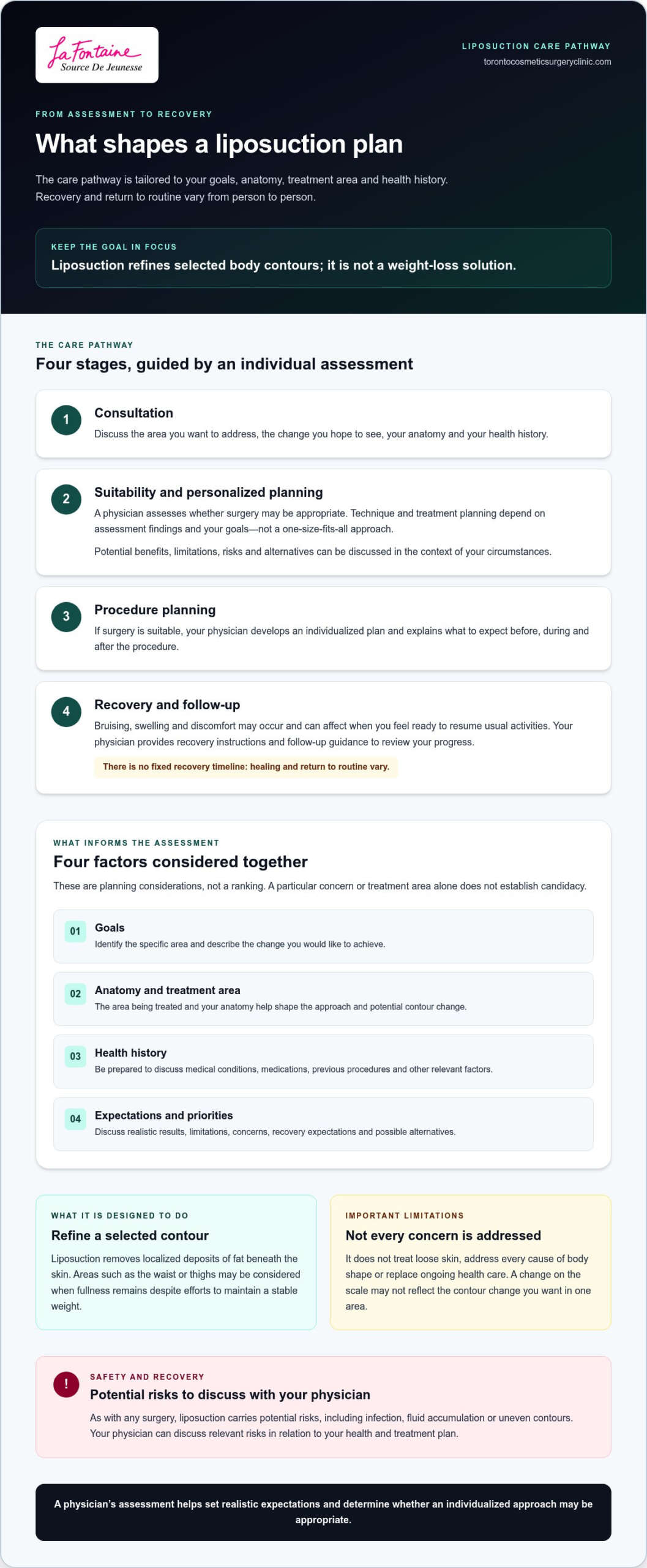
Liposuction is surgery that removes localized deposits of fat beneath the skin to refine body contours. It may be considered for areas such as the waist or thighs when fullness remains despite a person’s efforts to maintain a stable weight. The goal is to change the contour of a selected area, not to produce a broad change in body size. For an overview of the procedure and its background, see Liposuction.
The potential change depends on individual anatomy, the area being treated, and the goals discussed during clinical assessment. Liposuction doesn’t treat loose skin, address every cause of a body’s shape, or replace ongoing health care. It is surgery, so suitability and possible outcomes need to be considered in light of your health history and a physician’s evaluation.
Liposuction versus weight loss: setting a realistic goal
Weight loss affects overall body mass, while liposuction focuses on selected areas. A change on the scale may not reflect the contour change you hope to see in one area, and surgery isn’t a substitute for weight-management care or healthy habits. Before a consultation, consider which area concerns you most and describe the change you want in practical terms. This gives your physician a clearer starting point for discussing what may be realistic.
Before planning treatment, a physician considers your goals, anatomy, treatment area, and medical history. These factors help determine whether surgery may be appropriate and shape an individualized plan. At La Fontaine Cosmetic Surgery Clinic, board-certified physicians create personalized treatment plans following an assessment. During a consultation, you can discuss your expectations and health history, and learn how they inform the next steps.
Liposuction candidacy and planning: how personal goals shape the approach
A suitable plan starts with the person, not a preset technique. A physician considers the changes you want, the area you’re concerned about, your anatomy, and your health history. These details help establish whether surgery may be appropriate and what outcome is realistic for your circumstances. The American Society of Plastic Surgeons’ guidance on liposuction candidates also describes factors that can inform this conversation.
What to discuss when assessing liposuction suitability
Before your appointment, note the change you hope to see and gather relevant health information. Clear expectations help your physician understand what matters to you and explain what surgery may realistically address.
- Goals: Identify the specific area you want to discuss and the change you’d like to achieve.
- Health history: Be ready to discuss medical conditions, previous procedures, medications, and other relevant factors.
- Expectations: Explain your priorities and concerns, and discuss possible results and limitations.
- Planning: Ask how your anatomy and treatment area affect the approach, recovery, and alternatives.
At La Fontaine Cosmetic Surgery Clinic, board-certified physicians use each patient’s goals and medical history to create a personalized treatment plan. A consultation gives you the opportunity to explain your priorities and receive an assessment tailored to your circumstances.
Liposuction procedure and recovery: the care pathway and next steps
The care pathway begins with a consultation to review your goals, treatment area, anatomy, and health history. If surgery is suitable, your physician develops an individualized plan and explains what to expect before, during, and after the procedure. Follow-up care is part of the process, allowing your progress and recovery to be reviewed. The Mayo Clinic overview of liposuction procedure and recovery offers further general information about these stages.
Recovery differs depending on the procedure and the individual. Bruising, swelling, and discomfort may occur and can affect when you feel ready to resume usual activities. Your physician will provide recovery instructions and follow-up guidance. Don’t rely on a fixed timeline, since healing and return-to-routine timing vary. As with any surgery, liposuction carries potential risks, such as infection, fluid accumulation, or uneven contours. Your physician can discuss relevant risks in the context of your health and treatment plan.
Preparing for a liposuction consultation and recovery discussion
Bring clear questions so you can make the most of your appointment. You may want to note your priorities and write down questions about:
- Goals: The changes you hope to achieve and what results are realistic.
- Health history: Medical conditions, medications, and previous procedures.
- Benefits and risks: Potential benefits, limitations, risks, and relevant alternatives.
- Aftercare: Recovery expectations, activity guidance, and follow-up care.
La Fontaine Cosmetic Surgery Clinic’s board-certified physicians use your goals and medical history to shape a personalized plan. A consultation is a practical next step to discuss your circumstances and recovery questions. Consultations can be booked online or by phone.
Take the next step with a personalized plan
Liposuction is intended to refine specific body contours, not deliver overall weight loss. Whether it may suit you depends on your goals, anatomy, treatment area, and medical history. An individual assessment helps set realistic expectations and determine an approach tailored to your needs. Recovery and return to routine also vary, so discussing aftercare and potential risks is an important part of planning.
La Fontaine Cosmetic Surgery Clinic offers liposuction, with board-certified physicians creating personalized plans based on each patient’s goals and medical history. Bring your questions and priorities to a consultation to explore whether treatment aligns with your expectations and understand the next steps. Learn what shapes liposuction cost in Canada to better understand the factors behind a personalized quote. Book a consultation online or by phone to discuss your goals and move forward with clarity.
Frequently Asked Questions
What is liposuction, and what does it treat?
Liposuction is a surgical body-contouring procedure that removes localized fat to refine the shape of selected areas. It isn’t intended as a treatment for overall weight loss or a substitute for general health care. Whether it may be suitable, and what change may be achievable, depends on your anatomy, goals, treatment area, and an individual physician’s assessment.
Is liposuction a weight-loss procedure?
No. Liposuction is intended to refine contours in selected areas, not produce general weight loss or a particular change on the scale. A physician considers your desired changes alongside your anatomy, treatment area, and medical history when discussing suitability. An assessment also helps clarify potential benefits and limitations, so expectations can reflect your circumstances.
How long does recovery from liposuction take?
Recovery time varies with the extent of the procedure and each person’s healing. Swelling, bruising, or discomfort may affect daily activities, so there isn’t one timeline that applies to everyone. Follow the personalized post-operative instructions and follow-up plan provided by your care team, including guidance on when to resume usual activities.
What happens at a liposuction consultation?
A consultation covers your goals, the areas you’d like treated, your medical history, and what you can realistically expect. Your physician can explain potential benefits, limitations, risks, and recovery considerations based on your circumstances. At La Fontaine Cosmetic Surgery Clinic, board-certified physicians use this information to develop a personalized treatment plan and discuss appropriate next steps.