


Liposuction before and after photos offer a snapshot, not a promise of what your own results will look like. They can give you a visual example, but differences in posture, lighting, camera angle and healing stage can make a fair comparison difficult.
It’s natural to want a clear picture of what to expect. However, swelling and other changes during recovery can affect how treated areas appear, so an early photo may not show how the result looks as healing progresses. One selected example also cannot predict another person’s outcome.
This article explains how to assess before-and-after images, what factors may shape results and why healing context matters. You’ll also find practical questions to raise at a personalized consultation, including how your aesthetic goals and medical history inform your treatment plan. At La Fontaine Cosmetic Surgery Clinic, board-certified physicians develop individualized plans and provide post-operative follow-up. Use photos as a starting point for a realistic conversation about your own goals and options.
Key Takeaways
- Use liposuction before-and-after photos as visual examples, not predictions of your personal outcome.
- Compare photos of the same body area, view, posture, lighting and healing stage to focus on visible contour changes.
- Consider when each photo was taken, since appearance may change during recovery.
- Assess a case study by considering the person’s goals and context, image timing, and what the photos cannot show.
- Bring your goals, health history and recovery questions to a consultation, where a plan can be tailored to you.
Liposuction Before and After: What Photos Can, and Cannot, Show
When reviewing liposuction photos, focus on the visible changes without assuming they predict your own result. Before-and-after images can show changes in contour, but they’re only one part of the picture. They don’t guarantee a particular outcome or provide a complete record of someone’s care.
An illustrative photo shows one person’s experience; it cannot predict another person’s outcome.
What a liposuction before-and-after image can help you assess
Start with what the images actually show. If captions identify the treated body area and view, use those details to guide your comparison. Focus on the visible contour in that area rather than assuming the image explains changes elsewhere. For example, a photograph from one angle cannot establish how the same area looks from another view.
Captions and consistent presentation provide useful context, but photos don’t reveal a person’s medical history, surgical plan or healing experience. For a general overview of the procedure and its techniques, see Liposuction.
Why one patient’s photos cannot promise another patient’s result
Every person has their own anatomy and aesthetic goals. Treatment planning is individualized, and healing varies, so a result in a gallery shouldn’t be treated as a standard to match. The same apparent contour change may not be appropriate or achievable for everyone.
At La Fontaine Cosmetic Surgery Clinic, board-certified physicians develop personalized plans based on each patient’s goals and medical history. Use photos to start a thoughtful conversation, not as a substitute for an individual assessment. During a consultation, discuss what matters to you and how your circumstances inform suitable options.
When evaluating liposuction before and after images, separate what’s visible from what photographs cannot tell you. This distinction helps you ask more specific questions and set expectations around your own treatment plan rather than relying on someone else’s example.
How Liposuction Results Change During Healing
A photograph taken soon after liposuction may show a different appearance from one taken later. Healing can affect visible contour, and swelling is one factor that may influence how an area looks. The pace and course of healing vary, so a single image isn’t a complete picture of recovery or a reliable forecast for another patient.
A photo’s timing is essential context for understanding what its visible results show.
Why early post-operative photos may look different
An early photograph may show swelling and other effects of healing, making it harder to assess contour. That alone doesn’t explain why an area looks a particular way or indicate how it will look later. A photo can’t diagnose a concern, and you shouldn’t use someone else’s images to assess your own recovery.
For an overview of procedure expectations and considerations, the American Society of Plastic Surgeons provides information on what to expect with liposuction. For personal questions about symptoms, healing or care instructions, follow the guidance of your own medical team.
Why later photos still need context
A later image may show a different visible contour, but it still represents one person at one point in recovery. Treat captions as useful context only when the date or healing stage is accurate and approved for publication. If that information isn’t provided, don’t infer the person’s healing timeline from appearance alone.
For a fair visual comparison, consider whether the images show the same body area with similar angles, posture and lighting. Differences in these factors can change how contour appears, even when photos were taken at different recovery stages. Knowing when each photo was taken helps you distinguish possible healing-related changes from differences in how the images were made.
When reviewing liposuction before and after examples, focus on what is visible and what the captions reliably explain. Avoid drawing conclusions about the person’s surgical details, medical history or overall recovery, which a photograph can’t establish. Discuss specific healing questions with the care team familiar with your procedure and health history.
At La Fontaine Cosmetic Surgery Clinic, board-certified physicians develop treatment plans around each patient’s goals and medical history. A personalized consultation can put questions about healing and expected results in the context of your own plan.
How to Compare Liposuction Before-and-After Photos Fairly
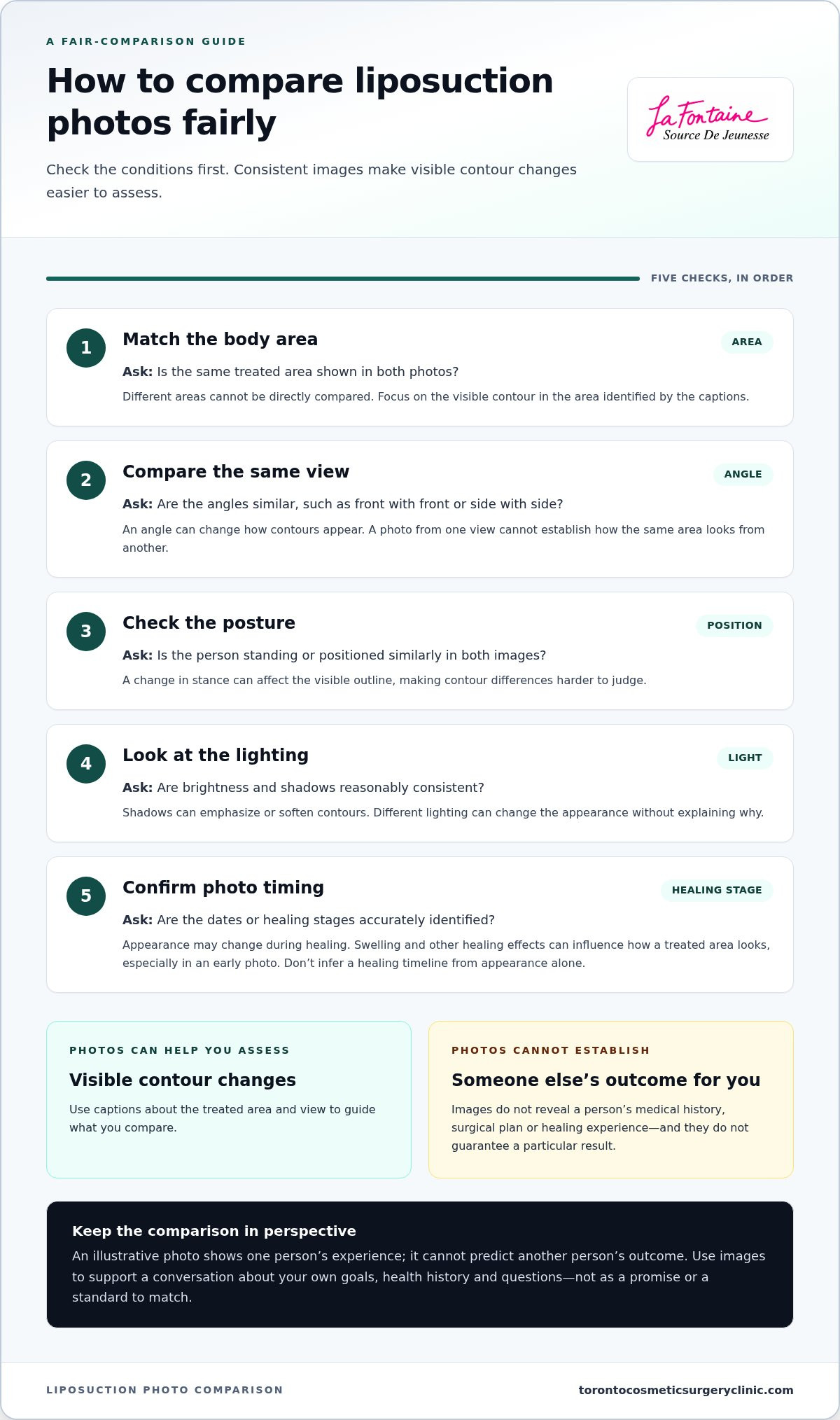
A fair comparison starts with the images, not assumptions about the person in them. Check whether both photos show the same treated area under similar conditions. Consistent framing helps you focus on visible contour rather than changes caused by the camera or the person’s positioning.
| Check | What to compare | Why it matters |
|---|---|---|
| Body area | Is the same area shown in both photos? | Different areas cannot be directly compared. |
| View | Are the angles similar, such as front or side? | An angle can change how contours appear. |
| Posture | Is the person standing or positioned similarly? | Stance can affect the visible outline. |
| Lighting | Are brightness and shadows reasonably consistent? | Shadows can emphasize or soften contours. |
| Photo timing | Are dates or healing stages accurately identified? | Appearance may differ during healing. |
Use consistent views and image conditions
Compare like with like wherever the approved photographs allow. A front view is most useful alongside another front view, and the same principle applies to side or angled views. Notice clothing, camera distance and framing as well. A closer crop or different garment can alter the impression of shape without showing a change in the treated area.
Posture matters, too. A relaxed stance and a turned or flexed position can present different contours. If the setup varies, treat the comparison as limited rather than trying to account for the difference yourself. Photographs also can’t establish the surgical technique used or the extent of treatment. For patient-friendly background on risks and recovery, MedlinePlus provides general information about liposuction.
Read captions and case details carefully
Use captions for details such as treatment area and photo timing only when they’re verified and approved for publication. Relevant context helps explain why two cases may not be comparable. People can have different anatomy, goals and treatment plans, even when photos show a similar area. Don’t rank patients or treat one body as a standard for another. Keep your comparison focused on what the images document.
Check the same body area, view, posture, lighting and photo timing before drawing conclusions. If key details are missing or conditions differ, note that limitation and interpret the comparison cautiously.
A Liposuction Before-and-After Case Study: How to Read One
A useful case study is more than a pair of photographs. It helps readers understand what the images show, what approved context adds and what remains unknown. This is a way to read a case, not a fabricated patient story or a promise of similar results.
Patient photographs should be approved for publication, used with the patient’s consent and paired only with verified captions. Keep observable details separate from clinical interpretation and recommendations for another person.
- Begin with the patient’s goals and verified context. Include a stated goal in a case description only when the patient has consented to share it. Health or treatment context should appear only when approved and medically reviewed. Without that context, don’t assume the person’s reasons for choosing liposuction or fill gaps with speculation.
- Review the approved images. Note only what is visibly different, using neutral, specific language. For example, describe a contour difference only if the images clearly support that observation. Captions may identify the body area or view, but don’t infer the treatment area, surgical details or extent of care from the pictures alone.
- Check the healing-stage context. Use a date or healing stage only when it’s accurately documented and approved for publication. Timing can help readers interpret what the images represent, but it doesn’t explain the full recovery experience. Don’t attribute a visible change to a particular stage or clinical cause unless the medical team has verified that interpretation.
- State the limitations. Photographs cannot show a patient’s medical history, surgical experience, care details or complete clinical course. They also cannot establish what another person should expect or which treatment plan is right for them. Keep the conclusion focused on the case shown, not on a prediction for the reader.
This approach makes a liposuction before-and-after case study more informative without overstating what it proves. A photograph can document a visible result in a specific context; it cannot provide an individualized assessment. At La Fontaine Cosmetic Surgery Clinic, board-certified physicians tailor treatment planning to each patient’s goals and medical history.
Bring questions about photos and your own goals to a personalized liposuction consultation. You can discuss suitable options in the context of your individual needs.
What to Discuss at a Liposuction Consultation After Viewing Photos
Use the photos you’ve reviewed to clarify what matters to you, not to set a result you expect to reproduce. A consultation is a personalized conversation about your goals, health history and suitable options. It’s also an opportunity to understand how your circumstances shape treatment planning and recovery guidance.
Turn inspiration into a clear, personal discussion
Bring questions or relevant examples that help explain what appeals to you. Point to a feature that caught your attention, such as the contour in a particular area, while recognizing that another patient’s image can’t establish what’s appropriate for you. Describe the areas and changes that matter most in your own words.
Your medical history is part of the discussion, too. Share relevant health information and ask how it informs planning. This helps the physician consider your circumstances and discuss suitable options without relying on assumptions drawn from a photo. A consultation isn’t a promise that a pictured result can be recreated.
To keep the conversation focused, consider preparing questions such as:
- Which aspects of this example are relevant to the goals I’ve described?
- What details about my health history should inform my treatment plan?
- What should I understand about my own recovery and follow-up?
- Which parts of a photo are useful for discussion, and which can’t predict my outcome?
Understand planning, procedure and follow-up
La Fontaine Cosmetic Surgery Clinic offers liposuction, and its board-certified physicians develop personalized treatment plans based on each patient’s goals and medical history. Use your consultation to discuss the proposed approach and ask how instructions and recovery guidance will be tailored to you. Individualized planning keeps the conversation centred on your needs rather than a gallery example.
Post-operative follow-up is part of the patient journey, and follow-up appointments are generally included in procedure fees. The details of your care and guidance are specific to your plan, so discuss what applies to you with your medical team.
Thoughtful liposuction before and after photos can help you prepare, but your own assessment is the essential next step. Book a personalized liposuction consultation to discuss your goals, health history and questions with the clinic’s physicians.
Move From Photo Examples to a Personal Plan
Liposuction before and after photos can help you identify visible changes and shape questions, but they can’t predict your individual outcome. Compare images thoughtfully by checking whether the body area, view, posture, lighting and timing are similar. Keep healing in mind, too, since appearance can change over time and a photograph captures only one moment.
The most useful next step is a conversation centred on your goals and health history. At La Fontaine Cosmetic Surgery Clinic, board-certified physicians use these details to develop personalized treatment plans. The clinic also includes post-operative follow-up appointments as part of its surgical care, supporting the care journey beyond procedure planning.
Bring examples that inspire you, along with questions about what they show and what they can’t tell you. Book a personalized liposuction consultation to discuss your goals and suitable options. A clear, individualized plan can help you move forward with confidence.
Frequently Asked Questions
Do liposuction before-and-after photos show typical results?
Not necessarily. Photos are selected examples of individual patients, not a complete picture of everyone’s experience or a statistical summary of typical outcomes. They can illustrate visible contour changes, but differences in anatomy, treatment planning, photo conditions and healing affect what each image shows. Read captions for verified context and treat images as discussion aids, not as a standard result to expect.
How long does it take to see liposuction results?
The timing varies, and an early appearance may differ from how the treated area looks as healing progresses. Swelling and other individual healing factors can affect visible contour, so a photograph taken at one stage may not represent the later appearance. There isn’t one timeline that applies to everyone. Your medical team can explain what to expect based on your procedure and provide recovery guidance for your situation.
Can liposuction before-and-after photos predict my results?
No. Liposuction before-and-after photos show one person’s experience and can’t predict your personal outcome. Your anatomy, aesthetic goals, medical history and individualized treatment plan all inform what may be appropriate for you. Use examples to explain what you like or what questions you have, then discuss your circumstances with a physician. A personalized assessment is more relevant to your planning than matching yourself to a photograph.
What should I look for in liposuction before-and-after photos?
Check whether the photos show the same body area from a similar view, with comparable posture, lighting, clothing, framing and camera distance. Look for verified captions that identify the area and photo timing. These details help distinguish visible contour changes from photographic differences. If important information is missing or the images were taken under different conditions, interpret the comparison cautiously and avoid drawing conclusions about surgical details or another person’s care.
Why can liposuction results look different in early photos?
Early photos may capture an appearance affected by healing, including swelling, so the visible contour can differ from what appears later. A photograph alone can’t explain the cause of a change or show how an individual’s recovery is progressing. Don’t use someone else’s images to assess your own healing or diagnose a concern. If you have questions about your recovery, contact your care team for guidance based on your circumstances.
Is liposuction a weight-loss procedure?
No. Liposuction is a body-contouring procedure, not a method for weight loss. It’s intended to address localized areas of fat, and it doesn’t replace weight-management care. Remaining fat cells can still enlarge with weight gain, so maintaining a stable weight can influence how results are preserved. Discuss your goals and health history with a physician to understand whether liposuction may fit your personal treatment plan.
What happens if my result does not look like the photos I viewed?
Photographs are examples, not promises, so your result may differ from images you’ve seen. If you’re concerned about your appearance or recovery, contact your care team and describe what you’re noticing. They can assess your situation in context. Avoid judging your outcome against someone else’s photos, especially if the images differ in timing or conditions. At La Fontaine Cosmetic Surgery Clinic, board-certified physicians base plans on each patient’s goals and medical history.